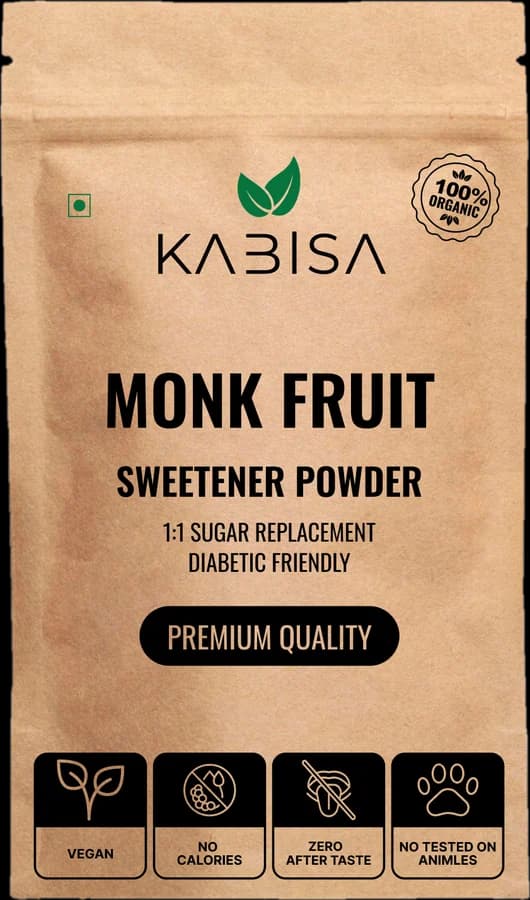
Monk Fruit Sweetener
A blend of monk fruit extract and erythritol that swaps spoon for spoon with sugar in chai, coffee, desserts and baking.
- Monk fruit extract and erythritol
- Swaps 1:1 for sugar
- Dissolves in chai and coffee
- Bakes and cooks like sugar (doesn't caramelise)
- Packs from 100 g to 800 g
Incl. of all taxes · 100 g
- Ships across India
- UPI and cards
- FSSAI licensed
About Monk Fruit Sweetener.
Monk fruit, or *luo han guo*, is a small round melon from southern China that has been dried and used to sweeten drinks for centuries. Its sweetness comes from compounds called mogrosides, which are many times sweeter than sugar, so only a little extract is needed.
Our Monk Fruit Sweetener blends monk fruit extract with erythritol, a sweetener made by fermentation. Together they look and pour like sugar and swap spoon for spoon, so you don't need to change your recipes.
How to use monk fruit sweetener
- Chai and coffee: use the same number of spoons you use for sugar. It dissolves fully in hot drinks.
- Desserts: kheer, halwa, custard, shrikhand and lassi.
- Baking: cakes, cookies and muffins, swapping 1:1 by volume. Bakes can brown a little less than with sugar.
- Cold drinks: lemonade, nimbu pani and iced tea. Stir well, or dissolve it in a little warm water first.
What does it taste like?
Clean and sweet, close to sugar. Some people notice a light cooling feeling from the erythritol, most of all in cold drinks and uncooked desserts.
A few practical notes
- Erythritol can feel heavy on the stomach if you eat a lot at once, so start with your usual amount and build up.
- It doesn't caramelise like sugar, so it isn't suited to recipes that need melted sugar, such as caramel or chikki.
- If you follow a medical diet, or are pregnant or taking medicines, please speak to your doctor about sweeteners.
Storage
Keep sealed in a cool, dry place. If it clumps in humid weather, break it up with a dry spoon.
Best before: 12 months from the date of packing.
How to use it
Use in place of sugar, spoon for spoon.
Product details
- Ingredients
- Monk fruit extract, erythritol
- Net quantity
- 100 g · 200 g · 400 g · 800 g
- Best before
- 12 months from the date of packing
- Storage
- Cool, dry place, away from sunlight.
- Packed by
- Kabisa Organics, 230 Avadh Viceroy, Sarthana Jakatnaka, Surat 395006
- Country of origin
- India
- FSSAI Lic. No.
- 20725031004161
- Customer care
- help@kabisa.in · +91 90990 00489
Questions
How much monk fruit sweetener replaces one spoon of sugar?
One spoon. It is made to swap 1:1 with sugar by volume, in drinks and in recipes.
What is in it?
Monk fruit extract and erythritol. The full ingredient list and nutrition label are on the pack.
Can I use it in chai and coffee?
Yes. It dissolves fully in hot drinks. Use the same number of spoons you use for sugar.
Can I bake with monk fruit sweetener?
Yes, swapping 1:1 for sugar. Cakes and cookies may brown a little less. It doesn't caramelise, so it isn't suited to caramel or chikki.
Why does it feel cool on the tongue?
That light cooling note comes from erythritol. It is most noticeable in cold drinks.
Is it suitable for diabetics?
We can't give medical advice. If you are managing diabetes or any health condition, please ask your doctor which sweetener is right for you.
Which pack size should I buy?
Try the 100 g pack first. For daily chai and coffee in a family, the 400 g or 800 g pack lasts longer and costs less per gram.
How should I store it?
Keep the pack sealed in a cool, dry place away from sunlight, and always use a dry spoon.
Who packs it?
Kabisa Organics in Surat, Gujarat. FSSAI Lic. No. 20725031004161.
Known across India as.
Monk Fruit Sweetener has a name in almost every Indian language. Here is what people call it.
- English
- Monk fruit, Luo han guo, Monkfruit sweetener
- Hindi
- मॉन्क फ्रूट (monk fruit)
- Botanical
- Siraitia grosvenorii
Reviews
No reviews yet. Bought Monk Fruit Sweetener? Tell others how you use it.